
Anxiety,stress & menopause
anxiety & stress therapy
your anxiety. Change the pattern. Feel more like yourself again.
Anxiety can affect much more than how you feel in the moment.
It can influence your thoughts, sleep, confidence, relationships, work and the things you feel able to do.
Perhaps you’re constantly worrying about what might happen, finding it difficult to switch your mind off, avoiding situations that make you uncomfortable or feeling that you’ve lost confidence in yourself.
Or perhaps you’ve reached a point where you think:
“I don’t want anxiety to keep controlling my life”
If that sounds familiar, you don’t have to work it all out on your own.
Does your anxiety make everyday situations feel threatening? Do you question yourself and avoid doing things that matter to you? You are experiencing anxiety, but that doesn’t mean that something is wrong with you, you can learn how to move beyond anxiety.
Your thoughts, feelings, physical sensations and behaviours can become part of a cycle, like a vicious circle.
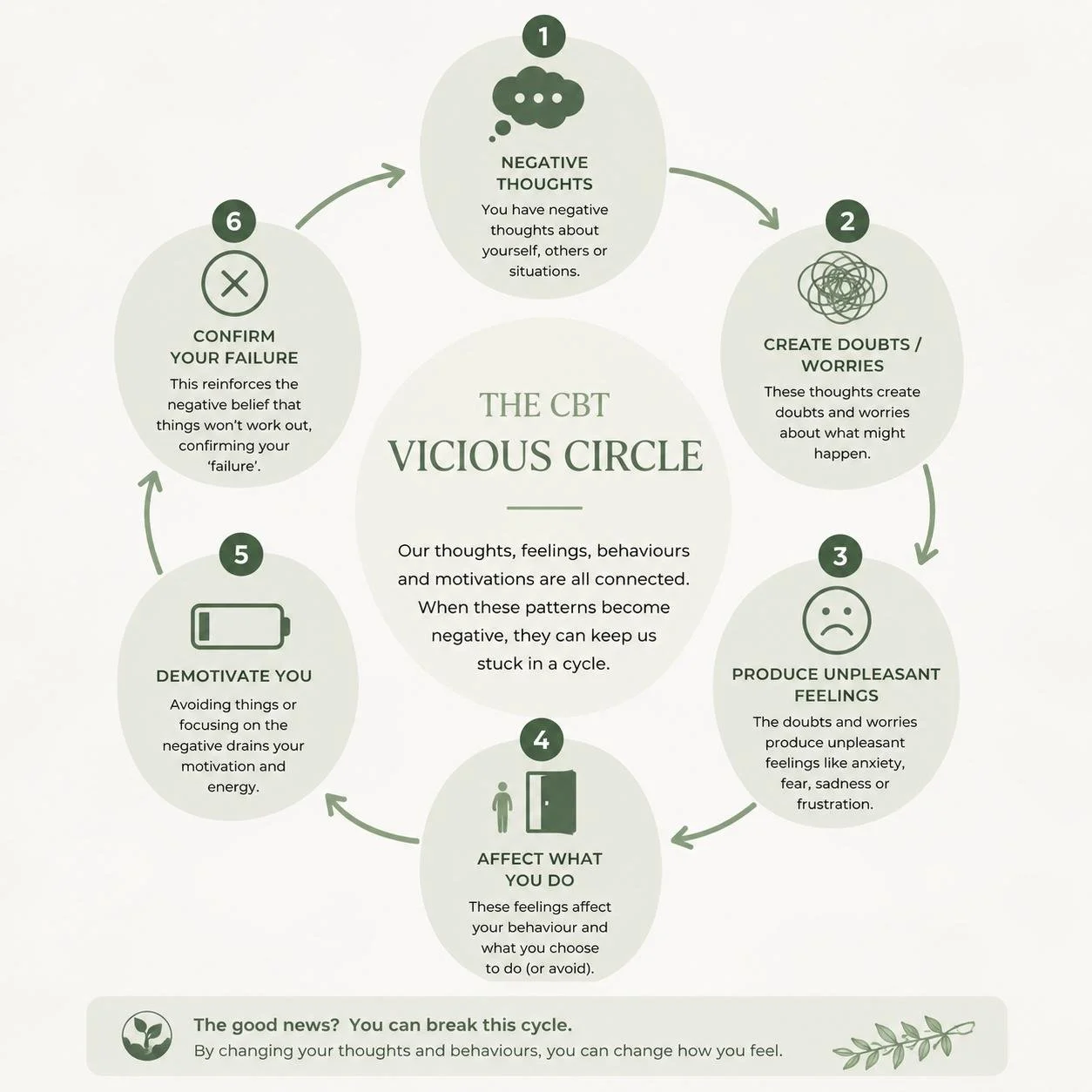
I offer personalised Cognitive Behavioural Hypnotherapy online to help you understand the patterns that may be keeping anxiety going and develop practical ways of responding differently.
What does anxiety feel like?
Anxiety isn’t the same for everyone.
For some people, it’s a constant feeling of worry or unease. For others, it might be panic, racing thoughts, physical sensations or a growing fear of situations that once felt manageable.
You may find yourself:
constantly worrying about the future
overthinking conversations or decisions
feeling on edge or unable to relax
experiencing panic or a racing heart
avoiding situations because they make you anxious
seeking reassurance from others
struggling with confidence
finding it difficult to sleep because your mind won’t switch off
worrying about your health or physical symptoms
feeling overwhelmed by everyday life
putting things off because you’re afraid of getting them wrong
Sometimes anxiety can become a cycle.
You feel anxious → you avoid or change what you do → you feel temporary relief → your brain learns that the situation must have been dangerous → the anxiety returns.
Over time, this can make your world feel smaller.
The good news is that these patterns can be understood and changed.
Anxiety can take many forms
General anxiety & excessive worry
When your mind seems to constantly search for things that could go wrong, it can be exhausting.
Therapy can help you understand patterns of worry, reassurance-seeking, avoidance and overthinking, and develop more helpful ways of responding.
Panic & physical anxiety
A racing heart, breathlessness, dizziness, sweating or a feeling that something terrible is about to happen can be frightening.
Understanding the relationship between anxious thoughts, physical sensations and behaviour can help you respond differently when anxiety appears.
Confidence & self-doubt
Anxiety can gradually change the way you see yourself.
You may start doubting your decisions, comparing yourself with others or avoiding things because you’re worried about getting them wrong.
Therapy can help you challenge unhelpful thinking patterns and rebuild confidence.
Fears & phobias
Sometimes anxiety becomes attached to a particular situation, object or experience.
Whether it’s a specific fear, a phobia or something you’ve gradually started avoiding, therapy can help you understand what is maintaining the fear and work towards greater confidence.
Sleep & anxiety
When your mind is busy worrying, switching off at night can feel almost impossible.
And when you’re not sleeping well, anxiety and stress can feel even harder to manage.
We can explore the thoughts, behaviours and patterns that may be keeping the cycle going.
Anxiety during perimenopause and menopause
When anxiety suddenly feels different
Perimenopause and menopause can bring a number of changes, and anxiety or mood changes can become a significant part of the experience for some women.
You may notice that you’re worrying more than you used to, feeling more on edge, struggling with confidence or experiencing anxiety that seems to have appeared without an obvious reason.
You might also be experiencing:
increased worry or overthinking
feeling more emotionally overwhelmed
panic or a racing heart
difficulty sleeping
irritability or mood changes
reduced confidence
difficulty concentrating or “brain fog”
increased health worries
feeling less able to cope with everyday demands
The NHS recognises anxiety and mood changes as possible symptoms around perimenopause and menopause, and sleep difficulties can also contribute to feeling stressed and anxious. (nhs.uk)
Can CBT help with menopause anxiety?
The NHS recommends considering CBT as one of the approaches that can help with anxiety, low mood and sleep problems associated with menopause. (nhs.uk)
This doesn’t mean that anxiety is simply “in your head”, or that you should ignore the physical changes taking place.
Instead, CBT can help you understand the relationship between your thoughts, feelings, physical sensations and behaviours — and identify ways of responding that may make things more manageable.
As a Cognitive Behavioural Hypnotherapist, I can help you work on areas such as:
Managing worry and overthinking
Learning to recognise unhelpful thinking patterns and develop different ways of responding.
Reducing the impact of anxiety
Understanding how anxiety affects your body and behaviour, and developing practical coping strategies.
Rebuilding confidence
Especially if anxiety has caused you to withdraw from activities or situations you previously enjoyed.
Improving your relationship with sleep
Exploring the anxiety and behavioural patterns that can make sleep more difficult.
Managing stress and feeling overwhelmed
Developing practical ways to create more calm and space in your everyday life.
If you’re experiencing new or troublesome menopause symptoms, it’s important to speak with your GP or another appropriate healthcare professional about your individual circumstances and treatment options. Psychological support can complement appropriate medical care; it doesn’t have to be either/or. (nhs.uk)
How Cognitive Behavioural Hypnotherapy can help
You don’t have to choose between understanding why you’re feeling anxious and learning how to change your response.
Cognitive Behavioural Hypnotherapy combines principles from Cognitive Behavioural Therapy with therapeutic hypnosis and other psychological techniques.
Together, we can explore:
What you’re thinking
The thoughts, beliefs and predictions that may be increasing your anxiety.
What you’re feeling
The emotions and physical sensations associated with anxiety.
What you’re doing
Avoidance, reassurance-seeking and other behaviours that may be maintaining the cycle.
What you can do differently
Practical strategies to help you respond in ways that support the life you want to live.
Therapy is collaborative and personalised to you.
There isn’t a one-size-fits-all approach to anxiety, so we’ll focus on what is happening for you and what you would like to change.
What if I don’t know why I’m anxious?
You don’t necessarily need to.
Sometimes there is an obvious reason for anxiety. Sometimes it seems to appear out of nowhere.
You may even be thinking:
“My life is actually fine. So why do I feel like this?”
There can be many factors involved in anxiety, including life circumstances, stress, learned patterns, physical symptoms, sleep and hormonal changes.
Our starting point is simply to understand what you’re experiencing and what you want to be different.
You don’t need to arrive with all the answers.
We can work them out together.
-
"Natasha was able to give me perspective, she acknowledged my feelings and did not judge or diminish my anxiety."
Client Testimonial
-
“I feel I am now more in control and can use these skills/coping strategies for other problems/situations in my life"
Client Testimonial